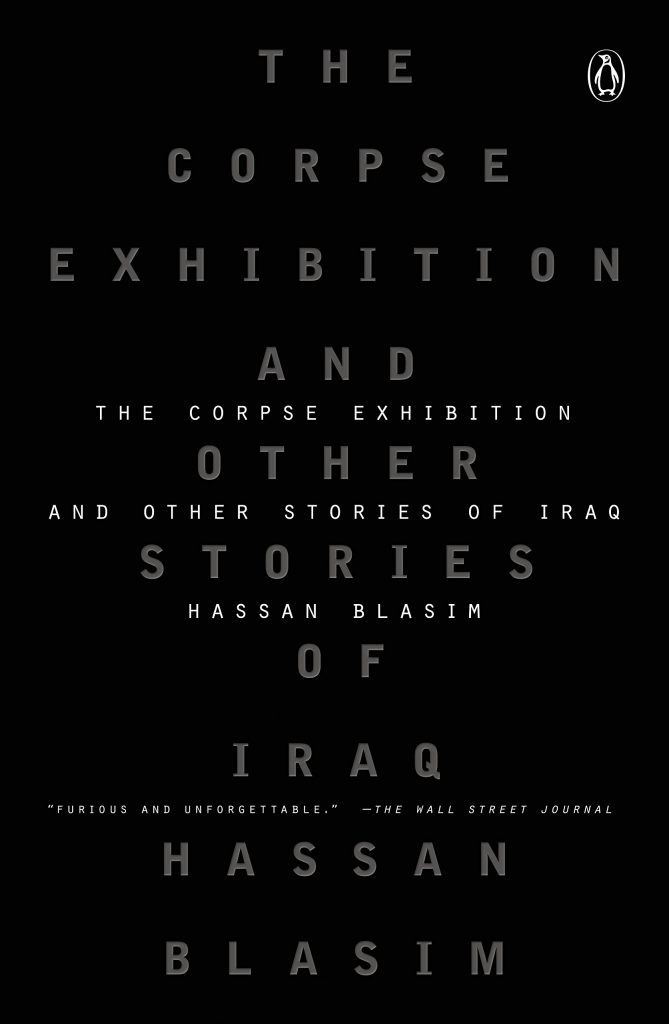
The Corpse Exhibition and Other Stories of Iraq by Hassan Blasim

Cover of The Corpse Exhibition and Other Stories of Iraq by Hassan Blasim

I read The Iraqi Christ by the same author – Hassam Blasim – and translator, Jonathan Wright, some time ago. You can see that review here. Though some of the stories appear in both collections my response to them has changed somewhat. They are still miraculous stories that play with the traditions of expositional storytelling and the magic of the jinn, but their exploration of violence and the workings of fate, predestination, or simply the arbitrary disconcern of the universe, feel more poignant and more painful to me. These are deeply philosophical and political stories that draw particular attention to the plight of those in war, and to refugees, teasing out the complexities of human conflict.

It would feel trite to give summaries of the stories, partly because I’m not sure I would do them justice after just one reading, but partly because you should go and read them for yourselves. I will, however, choose one story to quote from, ‘The Reality and the Record’ in which we listen to the story of a refugee telling his ‘official’ rather than his ‘real’ story to the immigration office. He says he was an ambulance driver in Baghdad who was serially kidnapped and forced, by different groups, to perform in videos, proclaiming a different identity and set of beliefs, which were then posted online to raise the profile and issues of the latest group who had kidnapped him. In his job as an ambulance driver, he had admired his boss whom he called the Professor. 

Continue reading The Corpse Exhibition and Other Stories of Iraq by Hassan Blasim

The Iraqi Christ by Hassan Blasim

This is a collection of short stories that made me want to reread even as I was reading. There is a pleasing mixture of the surreal and the contemporary real that bares the hallmark of great short story writing; think Borges, Kafka, George Saunders, Raymond Carver, Dambudzo Marenchera.

Blasim moves with ease from the fantastic tales of childhood and superstition, to bizarre snippets of human interest that highlight the grotesque and pointless moments of soul- or solace- searching in the daily lives of ordinary people. Men and women fall into time-warping holes (‘The Hole’) or try to remember what happened the day their brother fell into the septic tank (‘The Song of the Goats’). A woman dies from ingesting rat urine when out pleasuring her dog (‘Why Don’t You Write a Novel, Instead of Talking About All These Characters’, great title). A man living far from his country, from his family, obsesses over the life of a dung beetle, dreaming he is the larva growing inside a world of excrement and being lovingly cared for by his mother, pain (‘The Dung Beetle’). Concentrated crying can make knives disappear (‘A Thousand and One Knives’). An animal observes and is saddened by human behaviour (‘Dear Beto’). A drunkard goes home and becomes prisoner to his own imagination when he sees a wolf in his flat (‘The Wolf’). This same drunkard wonders if art is only ever the manifestation of another’s dream while another character questions if villagers stories about drought-bringing trees springing from a woman’s thoughts can be anything more than the babblings of the ignorant (‘Sarsara’s Tree’).

I’m not sure which story is my favourite. Sometimes it is weeks later that such favouritism rises into conscious musing and Blasim’s stories are definitely ones that will set my mind turning even when I consider myself to be thinking of something else. Ultimately, these stories are inspiring. They ask you to look closer, to think more deeply and in less well-travelled ways. They ask readers to pay attention not just to their stories but the world around them. This is the kind of writing that reminds you how powerful short stories can be. I definitely recommend The Iraqi Christ and will probably read his other collection very soon.

Next week I’ll be reading The Undertaking by Audrey Magee.