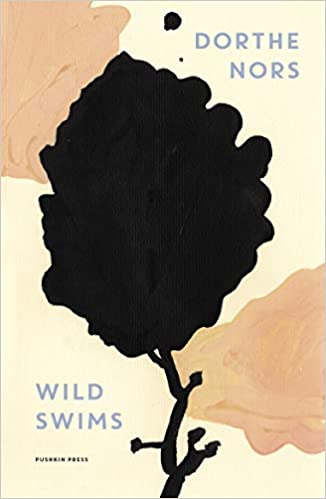
Wild Swims by Dorthe Nors, translated by Misha Hoekstra

Cover of Wild Swims by Dorthe Nors, translated by Misha Hoekstra

I’ve really enjoyed reading Dorthe Nors other works and was excited to read this collection. Wild Swims is such a beautiful title too and from the moment you dip your toe in, you are immersed in different lives all told at those moments of heightened awareness. Either a narrator is stuck up a deer stand with a damaged ankle and no phone (‘In a Deer Stand’) or they’re preparing to head out into the wilderness (‘Manitoba’) or they’re standing with a gas can staring out over a fairground contemplating what it means to be in love (‘The Fairground’ – where it isn’t the joyful flowers and rainbows you imagine as a child). 

Most of the stories feel like a brief immersion into one mind whose sense of present comprehension often involves a significant memory that somehow ties into that moment, that solidifies their sense of self-consciousness, their understanding of the world and themselves. These feel like stories in the classic Carver sense, tips of the ice-berg, Pritchard’s glimpses from the corners of eyes. 

Her use of imagery coheres with this too. A small thing seems to stand for how a character feels during a certain experience. The reflected sun spots on the ice of the Arctic tundra – the sun dogs as they are called in the language of the tundra – are the visible intangible rivals to the narrator’s ex, seen through the body of his mother whom she befriends on a writing retreat and who is so afraid of having her stories, her self written about (‘Sun Dogs’). The description of the image allows it to speak in ways the words can’t do alone. 

Continue reading Wild Swims by Dorthe Nors, translated by Misha Hoekstra

Mirror, Shoulder, Signal by Dorthe Nors

getimage-37Sonja is forty and wants to learn to drive. The instructions of the title represent all those automatic functions through which our lives are meant to pass: learning to drive, getting a job, getting married, having children etc. etc. But Sonja moved from the countryside – Balling, Jutland to be specific – to come to college and though she is now a translator working mostly on the crime novels of one author (she doesn’t even like crime fiction), she struggles to translate her country self into her town self and vice versa. She feels as if she doesn’t fit in either place.

To top it off, she’s fallen out with her sister who still lives in Balling, and her positional vertigo is playing up. Technically, anyone with positional vertigo probably shouldn’t even be allowed a driving license so she’s hiding the condition from her driving school.

When she was a child she hid in the fields, she ran off to look at the whooper swans and her mind keeps returning to the fields, to her ability to spot rogue stalks of wheat in the rye, to the necks and calls of the swans.

Her life is not as she expected. All those intimate connections are missing. Her sister avoids speaking to her and even the friend she moved to Copenhagen with has changed her name and used Sonja to cover for her marital indiscretions. So instead Sonja has a massage therapist to touch her and driving instructors she hopes will help her learn to change gear.

The story, perhaps, may not appeal to all, but the writing is so beautifully married to the darting, connective, fluctuations of consciousness in which current experience is responded to, challenged, influenced and ignored by memory, conjecture and nuanced interpretation, that the small moments of Sonja’s life are truly evocative and such a joy to read. Reading Mirror, Shoulder, Signal is like stepping into Sonja’s mind. This single woman in her forties may be depressed but her thoughts are multifaceted gemstones that sparkle under the light. Sometimes, someone needs to stand to the side of what it expected and ask why. Sometimes, someone needs to remember. Sonja is just that person. So even though the novel feels mundane, it is everything but. Not every journey requires a rite of passage. Not every person should learn to drive…

Those of you who know me will laugh at the last sentence, so I’ll come clean and admit I’m 40 and can’t drive either. I stand by my response to the book though. Driving represents a step on the ladder of life’s expectations. Just like the fortune teller Sonja meets at a party, this sense of having a future already laid out for you, is one Sonja deeply struggles with.

I thoroughly enjoyed this novel.

Next week I’m reviewing Strange Heart Beating by Eli Goldstone.


Minna Needs Rehearsal Space and Karate Chop by Dorthe Nors

Minna Needs Rehearsal Space is a novella published by Pushkin Press in one volume alongside the collection of short stories, Karate Chop, both translated from Danish by MIsha Hoekstra. It is a beautiful book, elegantly and sparsely printed so that each title has its own cover requiring a reader to turn the book upside down to read the other work. Even without the trappings however, this is a striking and beautiful volume of work that stays inside your mind long after you’ve finished reading.

Minna Needs Rehearsal Space is written in short sentences laid out like poetry in which Minna strives to rediscover her voice. She is a composer without fame struggling to maintain a relationship with a journalist. She needs rehearsal space and hasn’t been able to make a loud noise in weeks.

It would be easy to imagine finding the layout irritating. The short forms of social media messages, its tweets and texts, feel as if they have influenced Nors’ style but rather than inspire something that reflects a short attention span they demand attention, acting like vignettes that evoke a precise moment in order to convey a wider ongoing present and together they build a conscious flow that is Minna and her experience of the world. It is possible to pick out sentences –

Minna turns her face toward the sun.

Minna’s chest arches over her heart. (p41)

– but they work best together. Minna’s story is one of creative longing, of obsession even, and it is very powerful.

Karate Chop is just as powerful but written very differently. The characters of these stories speak of acts that fall under the radar, behaviours that are shocking not because they don’t happen but because they usually remain hidden. The snide abuse of relatives (‘Mother, Grandmother, and Aunt Ellen’), the kindnesses of men who live adulterous lives (‘Duckling’), the moment in which a parent stops being god-like (‘The Winter Garden’), all those obsessions and behaviours for which we have no straight-forward answers.

The title story typifies what is best about these short stories in its use of a metaphor about colouring in [it makes me wonder how this would extrapolate out into the latest adult colouring craze…]. Annelise often finds herself in abusive relationships and while she is considering her current situation she looks at her lover’s hand:

It looked gentle lying there. A little red across the knuckles, but there was nothing wrong with its outline, especially not if Annelise put her eyes slightly out of focus. She considered its shape and thought about the lines; everything you wanted to see but which in actual fact was not there. Everything that should have been but which never became, and this was important to understand. Not only in respect to herself. It was something she could put to use with the children at school. She recalled that as a child she had been heavily seduced by the black line drawings in coloring books. They were done so well she always wanted to fill the empty spaces with crayon and felt-tip. Behind that burning desire to color in the drawings lay the creative human’s longing to give life, and, not least: to make the drawings her own. In a way, it was like stealing preconceived ideas. The drawing could never be lifelike, and for that reason you reached a point where you began to draw outside the lines. (p73)

The idea of human relationships being about filling in the lines or drawing outside of them has a revelatory quality whose exploration is best read in the story itself, but I’m sure you can see its appeal; her stories have the quality of gems with multiple facets that reflect the light and the dark.

Clearly, I enjoyed Minna Needs Rehearsal Space and Karate Chop a great deal and would recommend it highly. It’s a quick but evocative read that forces the reader to think beyond its pages. Thank you to my Secret Santa who bought it for me for Christmas.

Next week (well this week), I’m reading the comic Bitch Planet, Book One: Extraordinary Machine by Deconnick and De Landro.